
Manager
Operational Essentials
Transforming Complex HR Processes into Actionable Manager Guidance

Project
Overview
Manager Operational Essentials is a multi-phase initiative focused on simplifying complex HR processes and improving manager effectiveness.
I co-lead the learning strategy, experience design, and content development in collaboration with HR leaders and cross-functional stakeholders. The initiative spans performance management, organizational change, hiring, onboarding, and workforce planning.

Organization: IBM for Red Hat
Role: Project Manager, Experience Designer
Focus: Enterprise Manager Enablement
The
Challenge
Managers were navigating complex people processes through fragmented resources, inconsistent guidance, and frequent reliance on HR support. These challenges created opportunities to improve clarity, consistency, and access to actionable guidance.
The challenge extended beyond creating more training. It required understanding where managers encountered friction, identifying opportunities for self-service, and designing practical solutions that supported informed decision-making while maintaining alignment with HR policies and processes.
Strategy &
Discovery
Learning Strategy & Program Architecture
Needs Analysis & Capability Gap Assessment
Data-Driven Decision Making
Stakeholder Engagement & Cross-Functional Collaboration
Workshop Design & Facilitation
Learner Personas & Experience Mapping
Discovery efforts combined an analysis of 1,721 manager support tickets, survey feedback from 65 HR stakeholders across nine functions, and collaborative design thinking workshops to identify recurring friction points, process gaps, and opportunities for improvement.
A custom analytics dashboard revealed that 64.9% of support requests could potentially be resolved through self-service, highlighting opportunities to improve guidance, reduce unnecessary HR involvement, and streamline processes.
To translate these findings into actionable priorities, I designed a series of collaborative workshops and Miro activities that guided stakeholders through identifying friction points, evaluating potential solutions, and prioritizing opportunities for improvement.
These insights informed a phased learning and content strategy focused on critical manager needs and operational improvement.
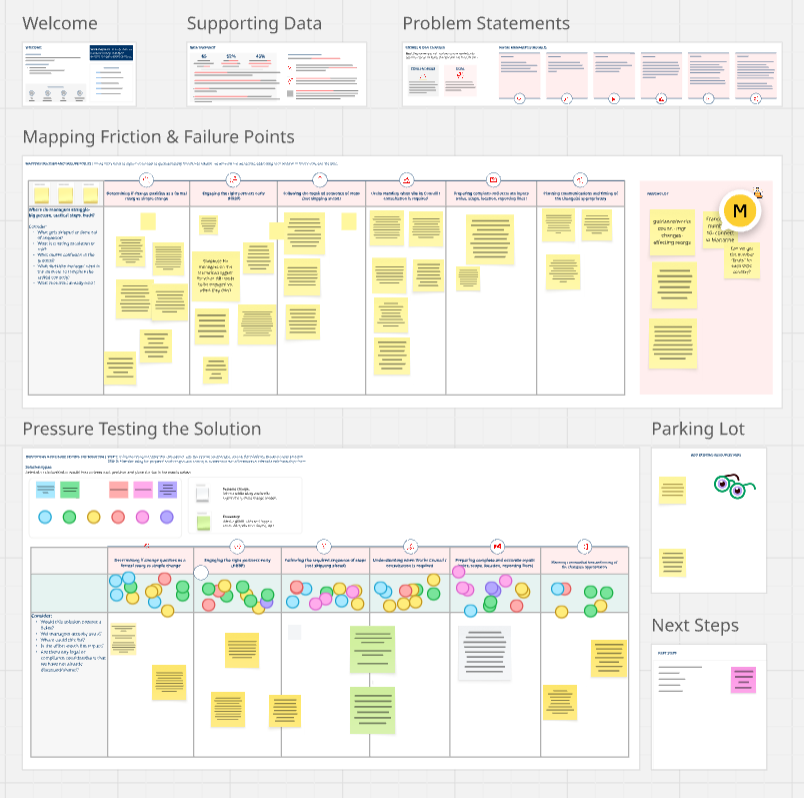
Design thinking Miro workshop designed to identify process friction, pressure-test potential solutions, and prioritize opportunities for improvement.
Design &
Development
Learning Experience Design (LXD)
Role-Based Learning & Performance Support
Instructional Design & Multimedia Development
User Experience (UX) & Accessibility
Content Strategy & Information Architecture
Learning Measurement & Evaluation Planning

Description
Research findings informed the learning architecture, content structure, and selection of delivery formats based on audience needs and opportunities for performance support.
The design process emphasized usability and practical application, translating complex HR processes into intuitive learning experiences and resources that could be used at the point of need.
Content governance was integrated into development to establish clear ownership, version control, and processes for maintaining accuracy as business needs evolve.
The
Solution

description 1

description 2

description 3
The resulting solution brought together learning resources, process guidance, and performance support tools to help managers and HR stakeholders navigate complex people processes with greater clarity and confidence.
A centralized resource hub provided an accessible starting point for understanding key processes and locating relevant guidance. Supporting resources included region-specific manager toolkits, knowledge base articles, HR enablement materials, and targeted instructional videos designed to address specific needs at the point of application.
Together, these resources created a more connected and consistent experience, balancing self-service access with the appropriate level of HR support. A supporting content governance structure established processes for maintaining resources and managing updates over time.
The program has demonstrated success in addressing operational inefficiencies, improving data accuracy, and strengthening compliance through more consistent execution of performance management processes.
Outcomes & Impact
XX%
Reduction in duplicate support tickets resulting from improved process guidance.
XX%
Reduction in incorrectly categorized requests, improving reporting accuracy and reducing manual rework.
XX%
Reduction in administrative processing time through clearer manager instructions and more effective self-service.
XX%
Increase in correct process adherence, supporting stronger data privacy and compliance practices.